
Steel Gauge Thickness Chart: Gauge to MM & Inches (7–22 GA)
Overview
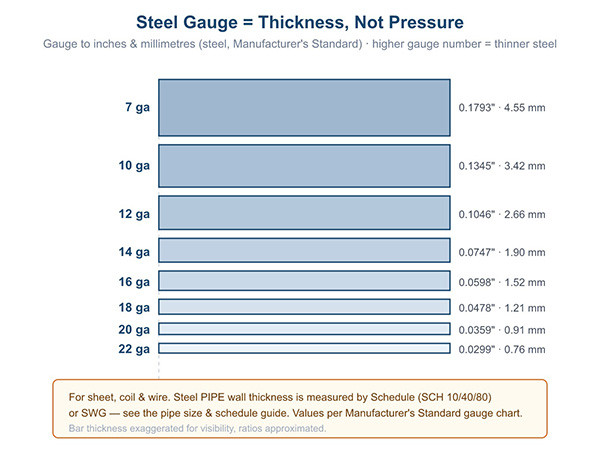
Confused by steel gauge numbers? You are not alone. "Gauge" is an old unit that works backwards — the higher the number, the thinner the steel — and the same gauge number means a different thickness for stainless steel, galvanized steel, or aluminum.
This guide gives you the conversion tables you actually need: steel sheet (7–22 gauge) to inches and millimetres, how to read the charts, and how to pick the right gauge for your project.
1.What Is A Steel Gauge?
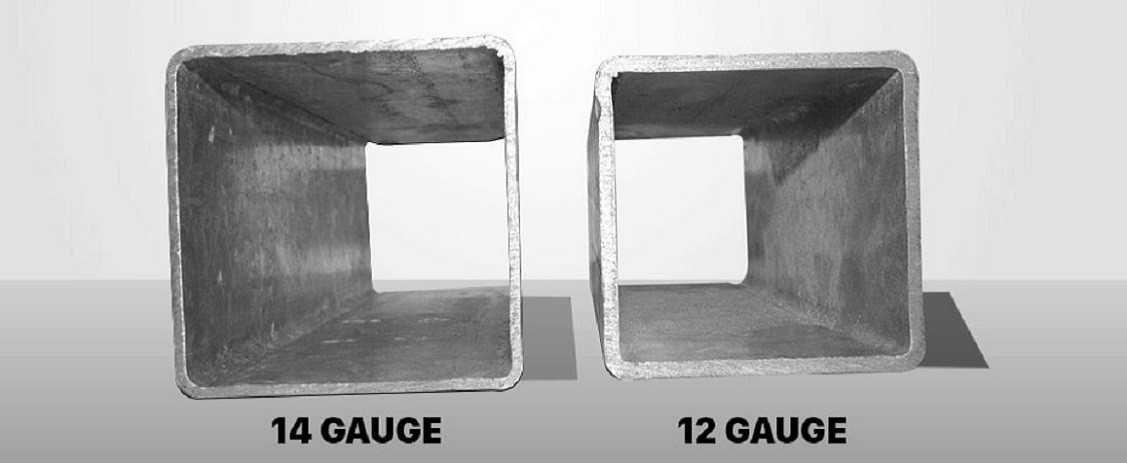
Steel gauge is a standardized method for measuring and distinguishing steel plate products, such as sheet metal, coil material,wire and pipe etc. Surprisingly, as the number of steel gauges increases, the thickness of the steel actually decreases. For example, 10 gauge steel is thicker than 12 gauge steel. The thickness of the steel plate varies from 3GA (thickest) to 38GA (thinnest). Note that "gauge" is sometimes spelled as "gage" or "GA" as an abbreviation.
2.A Brief History
The gauge system dates back to 19th-century British wire drawing, where
each gauge number matched the number of drawing dies the wire passed
through — more dies meant a thinner wire. The system survived because
sheet mills and buyers were already tooled around it. Today it coexists
with direct metric measurement, which is why every gauge number still
needs a conversion table.
3.Picking The Right Steel Gauge
For objects that require rigidity and edges, you can use thicker (or lower specification) steel. However, for some objects that require flexibility or flexibility, you need to use thinner (or higher specification) steel to adapt to this situation.
4.How To Read A Steel Gauge Thickness Chart?
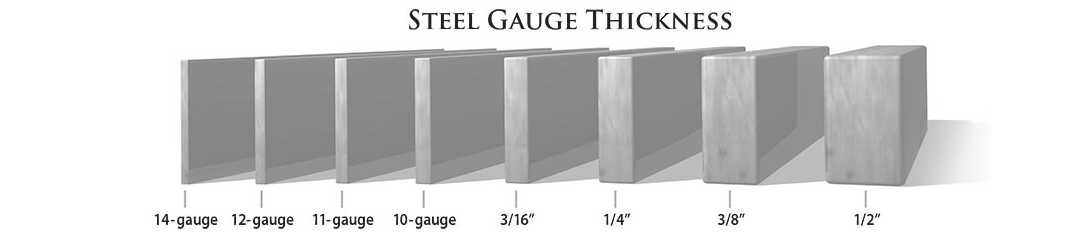
In practice, in most cases, we need to read the steel gauge thickness chart. Small through the organization, deliberately the commonly used metal steel gauge thickness table summarized down, next, take you to see how these tables are read, as well as what are the relevant content in the table.
4.1 Sheet Metal Gauge Chart
First, take a look at sheet metal gauge chart. Ferrous metals use a different metering system than non-ferrous metals like copper, which are measured in ounces per square foot.
4.2 Carbon Steel/Mild Steel Gauge Chart
4.3 Galvanized Steel Gauge Chart
4.4 Stainless Steel Gauge Chart
5.Summary
-Gauge measures thickness; higher number = thinner steel.
-The same gauge number means different thicknesses for carbon steel, galvanized, and stainless — always use the matching chart.
-For steel sheet, 12–14 gauge covers most fabrication work.
-Pipe wall thickness uses Schedule, not gauge — do not mix the two systems.
FAQ
Q1.How thick is 12 gauge steel?
12 gauge steel is 0.1046 inch thick, or approximately 2.66 mm. (The higher the gauge number, the thinner the steel.)
Q2.How thick is 20 gauge steel?
20 gauge steel is 0.0359 inch thick, or approximately 0.91 mm.
Q3.Which is thicker 10 or 11 gauge steel?
10 gauge steel is thicker than 11 gauge steel.
Q4.What is thicker 14 or 16 gauge steel?
14 gauge steel is thicker than 16 gauge steel.
Q5.What is better 12 or 14 gauge steel?
In the gauge system the higher the number the thinner the steel. As an example, 12 gauge steel is thicker and stronger than 14 gauge steel.
Q6.Is 10 gauge steel thick?
For sheet metal, a retrogressive scale (higher numbers mean lower thickness) that starts with 10 gauge representing a thickness of 3.416 millimeters or 0.1345 inches. ... For example, a 12 gauge sheet is 2.732 millimeters thick, and a 13 gauge sheet is 2.391 millimeters thick.
Q7.Is 10 gauge steel strong?
A door made from 10-gauge (. 135) steel is over twice as strong as one made from 12-gauge (. 106) steel even though it is only . 029 thicker (see Steel Strength Chart).
Q8.What is thicker 12 or 13 gauge steel?
12 gauge steel is thicker than 13 gauge steel.
Need Steel in a Specific Gauge?
We supply carbon steel sheet, coil, and pipe as a manufacturer — not a
trader. Send us your gauge number, dimensions, and quantity, and our team
replies with a mill price within 24 hours. Mill test reports and
third-party inspection (SGS/BV) available on every order.
→ Browse Our Steel Pipe Catalog
Not sure which gauge fits your project? Tell us your application and load
requirements — we recommend the right thickness free of charge.