
What Is a Hollow Section?
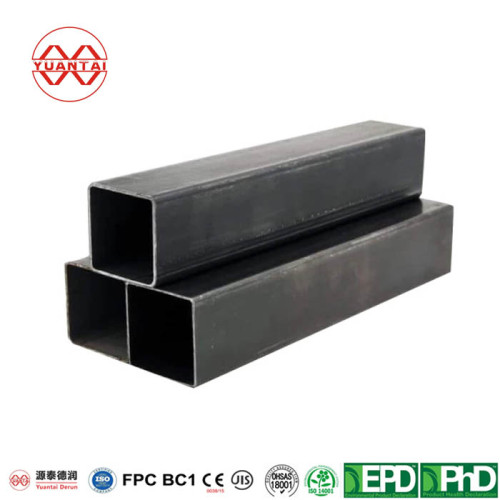
A hollow structural section (HSS) is a closed steel profile used primarily to carry structural loads. In European and many international projects, the product is more commonly called a structural hollow section or simply a hollow section.
Unlike open steel profiles such as I-beams, channels and angles, a hollow section distributes steel around a closed perimeter. This geometry can provide efficient resistance to compression, bending and torsion while maintaining a smooth, clean external profile.
Hollow sections are widely specified for building columns, structural frames, bridge and roof trusses, solar mounting systems, stadium roofs, offshore structures, machinery frames and fabricated steelwork.
The best shape is not simply the “strongest” one. Selection depends on loading direction, member length, buckling requirements, connection design, fabrication method, available sizes, coating requirements and the governing project standard.
SHS, RHS and CHS: What Is the Difference?
The cross-sectional shape affects the section’s bending properties, torsional performance, connection details and visual appearance.
| Shape | Description | Best suited to | Typical applications | Main consideration |
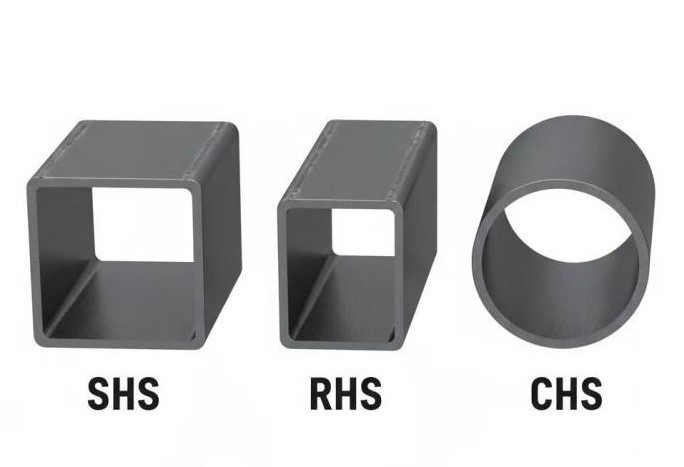
| SHS | Equal width and height | Balanced loading about two principal axes | Columns, frames, space structures, architectural steelwork | Usually less weight-efficient than RHS where bending is mainly in one direction |
| RHS | Unequal width and height | Directional bending about a major axis | Beams, trusses, portal frames, equipment frames | Major- and minor-axis section properties differ |
| CHS | Circular cross-section | Compression, torsion and multi-directional loading | Columns, trusses, offshore structures, handrails and tubular frames | Connections may require more specialized cutting, welding and detailing |
Square Hollow Section
SHS has equal outside dimensions, such as 100 × 100 mm or 150 × 150 mm. It provides similar section properties about both principal axes and is commonly used for columns, frames and exposed architectural steelwork.
Rectangular Hollow Section
RHS has unequal width and height dimensions, such as 200 × 100 mm. Its larger dimension provides greater bending resistance about the major axis, making it suitable for beams, trusses, solar structures and fabricated frames.
Circular Hollow Section
CHS has a circular cross-section and uniform properties around its axis. It is particularly effective for compression, torsion and loading from several directions.
CHS is widely used for tubular columns, trusses and architecturally exposed structures. However, circular-section connections can require more complex cutting, fitting and welding than comparable SHS or RHS connections.
As a general starting point, RHS is often considered for directional bending, SHS for balanced framing requirements, and CHS for compression, torsion or multi-directional loading.
How Are Hollow Sections Made?
Structural hollow sections can be produced through welded or seamless manufacturing routes.
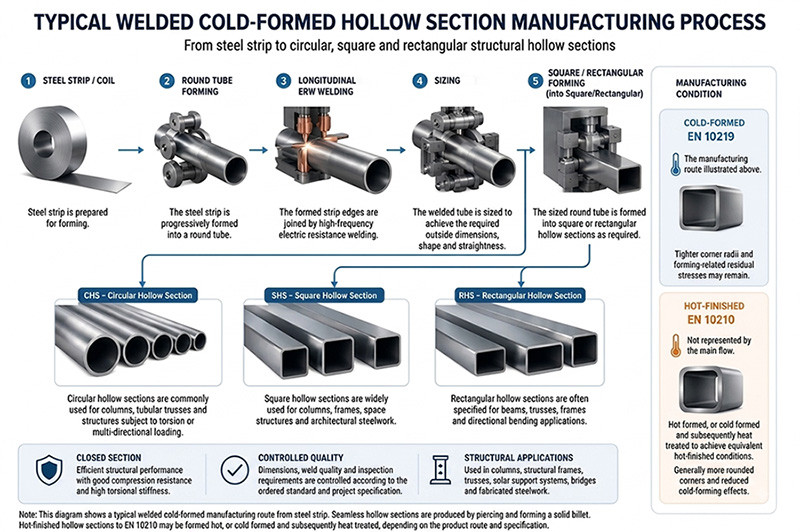
Welded hollow sections are usually made from steel strip or plate. Welded sections are commonly formed from steel strip or plate, joined along a longitudinal seam, and then supplied as round, square or rectangular sections depending on the manufacturing route and product specification.
Seamless hollow sections are generally made by piercing and forming a solid steel billet. They may be specified where the project standard, product size, service condition or customer requirement calls for seamless material.
These terms describe different parts of the manufacturing process: welded or seamless refers to the joining route, while cold-formed or hot-finished refers to the forming or finishing condition.
Welded or seamless describes the product’s joining route.
Cold-formed or hot-finished describes the forming or final manufacturing condition.
Cold-Formed Hollow Sections
Cold-formed hollow sections are shaped at ambient temperature from strip or plate. They offer good dimensional consistency and are widely available in square, rectangular and circular forms.
EN 10219 covers cold-formed welded structural hollow sections. Cold forming can leave residual stresses in the section and usually produces tighter corners in SHS and RHS than hot-finished products.
Hot-Finished Hollow Sections
Hot-finished hollow sections are produced or finished at elevated temperatures. The process can reduce forming-related residual stresses and generally results in more rounded corners in SHS and RHS products.
EN 10210 covers hot-finished structural hollow sections and may include welded or seamless products, depending on the applicable product route and specification.
EN 10219 material should not automatically replace EN 10210 material simply because dimensions or weights are similar. Always confirm the project standard, grade, tolerances, inspection requirements and any approved substitution procedure.
Hollow Section Standards and Specification
The applicable standard is normally specified by the project and should be confirmed together with the manufacturing route, grade, dimensions and inspection requirements.
| Standard | Typical market | Main scope |
| EN 10219 | Europe and EN-based projects | Cold-formed welded structural hollow sections |
| EN 10210 | Europe and EN-based projects | Hot-finished structural hollow sections |
ASTM A500 | North America and ASTM projects | Cold-formed carbon steel structural tubing |
ASTM A501 | North America and ASTM projects | Hot-formed carbon steel structural tubing |
GB/T 6728 | China | Cold-formed steel hollow sections for general structural use |
ASTM A500 includes cold-formed welded and seamless carbon steel structural tubing, while ASTM A501 covers hot-formed welded and seamless structural tubing.
GB/T 6728 is commonly used for Chinese cold-formed hollow-section products. It should not be assumed to be automatically interchangeable with EN 10219, EN 10210 or ASTM A500. Before ordering, confirm the required steel grade, mechanical properties, tolerances, testing and inspection documents.
For a detailed European-standard comparison, see our EN 10219 vs EN 10210 guide.
A complete hollow-section specification should include:
Shape: SHS, RHS or CHS
Outside dimensions and wall thickness
Applicable standard and steel grade
Welded, seamless, cold-formed or hot-finished condition where relevant
Length, length tolerance and end condition
Surface condition: black, painted or hot-dip galvanized
Inspection, testing and certification requirements
Quantity, delivery location and project-specific requirements
Example specification:
RHS 200 × 100 × 6.0 mm, EN 10219 S355J2H, cold-formed welded structural hollow section, 12 m fixed length, black surface, EN 10204 3.1 inspection certificate required.
For outdoor or corrosive environments, hollow sections can be hot-dip galvanized. Closed fabricated members require properly designed vent and drain holes before galvanizing so air, cleaning solution and zinc can flow safely through the member.
Hollow Section vs Steel Pipe
Hollow sections and steel pipes can have similar shapes, especially in round form, but they are normally specified for different purposes.nt
| Item | Structural hollow section | Steel pipeSteel pipe |
| Primary purpose | Structural load carrying | Fluid conveyance or defined service duty |
| Common standards | EN 10219, EN 10210, ASTM A500, ASTM A501 | API 5L, ASTM A53, ASTM A106 and others |
| Design focus | Strength, stiffness, buckling and connections | Pressure, temperature, fluid service and corrosion allowance |
Typical use | Columns, frames, trusses and solar structures | Water, oil, gas, steam and process systems |
Shape alone does not determine how a tubular steel product is specified. A round tube can be used structurally, while pipe can form part of a supporting system. The applicable standard, intended service and project specification determine how the product should be selected.
API 5L PSL1 and PSL2 are not applicable to structural hollow sections specified under EN 10219, EN 10210 or ASTM structural tubing standards. PSL1 and PSL2 are API 5L line-pipe product specification levels, not grades for EN 10219, EN 10210 or ASTM structural tubing.
Frequently Asked Questions
Q1:What does HSS stand for?
A:HSS stands for Hollow Structural Section. The main forms are square, rectangular and circular hollow sections.
Q2:What is the difference between SHS, RHS and CHS?
A:SHS is square, RHS is rectangular and CHS is circular. RHS is useful for directional bending, SHS provides balanced properties about two axes, and CHS performs well in compression, torsion and multi-directional loading.
Q3:Can EN 10219 replace EN 10210?
A:Not automatically. The two standards cover different manufacturing conditions and technical requirements. The project specification must determine whether substitution is acceptable.
Q4:Can hollow sections be galvanized?
A:Yes. Hollow sections can be hot-dip galvanized for corrosion protection. Closed fabricated members need correctly positioned vent and drain holes before galvanizing.
Q5:What should buyers confirm before ordering?
A:Confirm the required standard, grade, dimensions, wall thickness, length tolerance, surface treatment, inspection documents and delivery requirements. Do not approve a substitution based only on similar dimensions or unit weight.
This guide is for general product-selection information. Final structural design, connection design, product substitution and standard compliance should be verified against the project specification and applicable design code.