
Steel Pipe Thickness: Avoid the 0.1mm Burr Trap
If you’ve ever been on a job site where the inspector’s micrometer doesn’t match the Mill Test Certificate, you know the frustration. Usually, the first instinct is to blame the manufacturer for "thin walls." But in my years on the factory floor at Yuantai Derun, I’ve found that the culprit isn’t always the steel—it’s often a tiny, sharp ridge of metal called a burr.
For anyone working with structural sections, especially high-demand 11 Gauge pipes, understanding how to bypass this
What Exactly is a Burr?
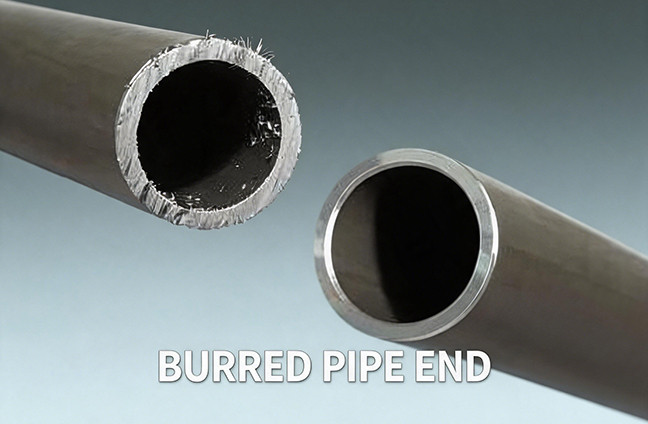
When a high-frequency ERW pipe is cut to length, the shear blade doesn't just slice; it displaces metal. This mechanical pressure forces a small amount of steel to curl outward at the cut edge.t
To the naked eye, it looks like a clean cut. To a precision micrometer, it’s a mountain. If you place your tool directly on that edge, you aren’t measuring the wall; you’re measuring the wall plus the displaced scrap. This usually adds a "ghost thickness" of 0.1mm to 0.3mm to your reading.
Sample Content Burr Trap" is the difference between professional QC and a rejected shipment.
The YTDR "Zone of Truth" Protocol
To get a measurement that actually reflects the structural integrity of the pipe, you have to move away from the noise. Our engineering team follows a simple but non-negotiable rule: The 20mm Offset.
Never take a reading at the very tip of the pipe. By sliding your calipers or micrometer just 20mm to 50mm back from the cut end, you reach what we call the "Zone of Truth." Here, the steel is unaffected by the shearing force of the saws. This is the only place where the gauge reflects the true thickness of the coil used in production.
Why Traditional Calipers Aren't Always Enough
In a perfect world, every pipe would be perfectly concentric. In reality, manufacturing tolerances exist. If you’re only measuring one spot, you’re only getting 25% of the story.
For high-spec projects—think solar mounting arrays or heavy-duty infrastructure—we ditch the hand tools for Ultrasonic Thickness Gauges. These devices use high-frequency sound waves to "see" through the metal. It allows us to verify thickness at any point along the 12-meter length of a pipe, not just the accessible ends. It’s the only way to catch mid-body thinning that manual inspection simply misses.
Eliminating the "Trust Gap" with Digital MTCs
We know that a professional buyer isn’t just looking for steel; they’re looking for peace of mind. The biggest risk in our industry isn't just a bad measurement—it's a fake or outdated document.
This is why we’ve moved beyond paper. Every structural section leaving our facility is linked to a Digitized MTC.
When you scan the QR code on our product tags, you aren't just seeing a static PDF. You’re accessing the "DNA" of that specific batch. It pulls the real-time QC data from our automated sensors, including the exact chemical heat number and the verified wall thickness from our final inspection line. It’s our way of putting the factory’s transparency directly into your smartphone.
Final Thought
A 11 Gauge pipe is only as strong as its thinnest point. Don't let a cutting burr give you a false sense of security, and don't accept a supplier who can't prove their data with digital traceability. Precision starts with how you measure, but it ends with who you trust.
Technical FAQ: Mastering Steel Pipe Accuracy
Q1: Why is the "20mm Offset Rule" critical for wall thickness checks?
A: When an ERW pipe is cut, the mechanical pressure creates microscopic burrs and slight metal displacement at the edge. Measuring here often adds a "ghost thickness" of 0.1mm to 0.3mm. By moving the micrometer 20mm to 50mm inward, you reach the "Zone of Truth"—where the steel remains in its stable, manufactured state, ensuring your 11 Gauge specs are real, not inflated.
Q2: Can I use standard calipers for high-precision structural projects?
A: Standard calipers are fine for quick checks, but for structural compliance, we recommend Digital or Ball-Anvil Micrometers. A flat anvil can sometimes slip on the curvature of a pipe, while a ball-anvil micrometer makes point-contact with the inner wall, providing a far more reliable reading for circular or square sections with specific R-angles.
Q3: What is the acceptable tolerance for a 3.0mm (11 Ga) wall thickness?
A: This depends on the standard (ASTM A500 vs. EN 10219). Generally, tolerances range between ±5% to ±10%. However, our internal YTDR protocol aims for the tighter end of that spectrum. We believe that precision at the manufacturing stage saves our clients from structural headaches during site assembly.