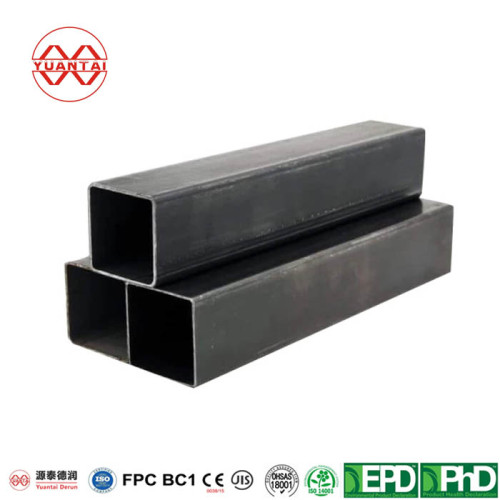

Moment of Inertia & Section Modulus of Steel Tubes
Quick Answer
The moment of inertia (I) describes a steel tube's resistance to bending deformation and is commonly used in deflection calculations. The section modulus (S) relates a section's geometry to the bending stress produced by a given bending moment.
For a given tube geometry, both values come from the cross-sectional dimensions and wall thickness. They do not depend directly on the steel grade.
In practical terms:
I is primarily used when checking stiffness and deflection.
S is used when calculating bending stress.
Section size and wall thickness both affect I and S, but increasing the overall section depth can be a particularly effective way to increase bending stiffness.
This guide explains the two properties in plain English, provides formulas for common hollow sections, gives section-property tables for selected square and rectangular tubes, and works through two simple examples.
What Is Moment of Inertia?
The moment of inertia of area, also called the second moment of area, is a geometric property that describes how the material in a cross-section is distributed around a bending axis.
The farther material is located from the neutral axis, the more strongly it contributes to bending stiffness.
Think aout a steel ruler. Lay it flat and push down on it, and it bends relatively easily. Turn it onto its edge and push again, and it becomes much harder to bend. The steel has not changed. The difference is how far the material is distributed from the bending axis.
This is one reason hollow steel sections are efficient structural members. Much of the steel is located away from the neutral axis, where it contributes more effectively to bending stiffness.
For a rectangular section, the dimension perpendicular to the bending axis has a particularly strong influence because it enters the moment-of-inertia equation to the third power.
Key takeaway: A higher I generally means greater bending stiffness and lower elastic deflection for the same material, loading, span, and support conditions.
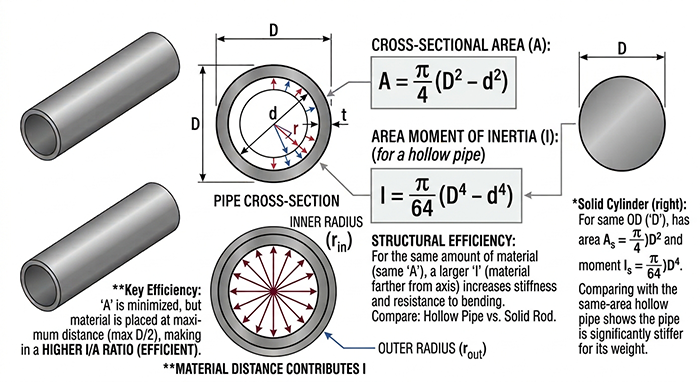
What Is Section Modulus?
The section modulus (S) is a geometric property derived from the moment of inertia:
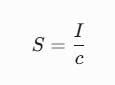
where c is the distance from the neutral axis to the outermost fiber.
Section modulus is used to relate bending moment to bending stress:
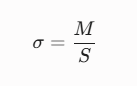
where:
σ = bending stress
M = bending moment
S = section modulus
A larger section modulus means a lower calculated bending stress for the same bending moment.
That does not mean S alone determines whether a tube is safe. Structural design can also be governed by local buckling, overall stability, shear, axial loading, connections, material strength, and the requirements of the applicable design code.
A useful way to remember the difference is:
I is mainly about stiffnessa and deflection; S is used for bending stress checks.
Moment of Inertia vs. Section Modulus
You are checking | Use | Why |
|---|---|---|
Will the beam deflect too much? | Moment of inertia (I) | Elastic deflection depends on section stiffness, which includes I |
What bending stress develops under a given moment? | Section modulus (S) | σ = M/S |
Comparing bending stiffness between sections | I | A larger I generally means greater stiffness |
Comparing stiffness relative to weight | I ÷ weight | Useful for comparing structural efficiency |
Specifying a structural tube | Both | I and S answer different design questions |
For many beam applications, a section can have plenty of strength while still exceeding the allowable deflection. That is why checking I can be just as important as checking strength.
Formulas for Square, Rectangular and Round Steel Tubes
The following formulas treat the section as a sharp-corner hollow shape. Actual SHS and RHS products have corner radii, and published section-property tables may therefore differ slightly from values calculated using these simplified equations.
Square Tube
For a square tube with outside dimension a, wall thickness t, and inside dimension:
b = a − 2t
the moment of inertia about either centroidal axis is:
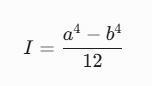
For a square section:
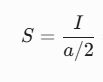
or:
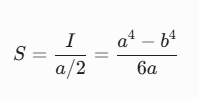
Rectangular Tube
For a rectangular tube with:
B = outside width
h = outside height
B₁ = inside width
h₁ = inside height
the moment of inertia about the strong axis is:
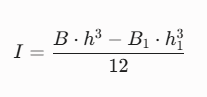
The corresponding section modulus is:
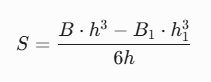
For the weak axis, the width and height terms are interchanged.
Round Pipe
For a circular pipe with outside diameter D and inside diameter d:
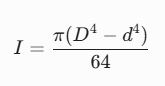
and:
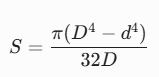
The formulas also show why section dimensions matter so much. For geometrically similar sections, I scales with the fourth power of a linear dimension. However, this does not mean that simply doubling the outside size while keeping wall thickness unchanged will produce exactly 16 times the I value.
Wall thickness also matters. Increasing thickness increases I and S, while also increasing weight. Very thin walls can introduce local buckling or slenderness limits, so increasing the overall section size is not automatically a substitute for adequate wall thickness.
Section Properties Charts: Square & Rectangular Tubes
The following values are calculated from nominal dimensions using standard geometric formulas and are intended for quick comparison and preliminary checks.
Actual section properties can vary slightly because real hollow sections have corner radii and dimensional tolerances. For final structural design, use the applicable standard, project specification, and manufacturer data.
Table 1: Square Tubes — Moment of Inertia & Section Modulus
Size (mm) | Wall (mm) | Weight (kg/m) | I (cm⁴) | S (cm³) |
|---|---|---|---|---|
50×50 | 3.0 | 4.43 | 20.8 | 8.3 |
50×50 | 4.0 | 5.78 | 26.2 | 10.5 |
60×60 | 4.0 | 7.03 | 47.1 | 15.7 |
80×80 | 4.0 | 9.54 | 117.4 | 29.3 |
80×80 | 6.0 | 13.94 | 163.2 | 40.8 |
100×100 | 4.0 | 12.06 | 236.3 | 47.3 |
100×100 | 6.0 | 17.70 | 333.6 | 66.7 |
120×120 | 5.0 | 18.06 | 507.9 | 84.7 |
150×150 | 6.0 | 27.13 | 1,196.5 | 159.5 |
200×200 | 6.0 | 36.55 | 2,923.3 | 292.3 |
The table illustrates an important point. Going from 80×80×4 to 100×100×4 increases nominal weight by about 26%, while I approximately doubles from 117.4 to 236.3 cm⁴.
That is why section depth deserves attention when comparing structural tube options, rather than looking only at wall thickness.
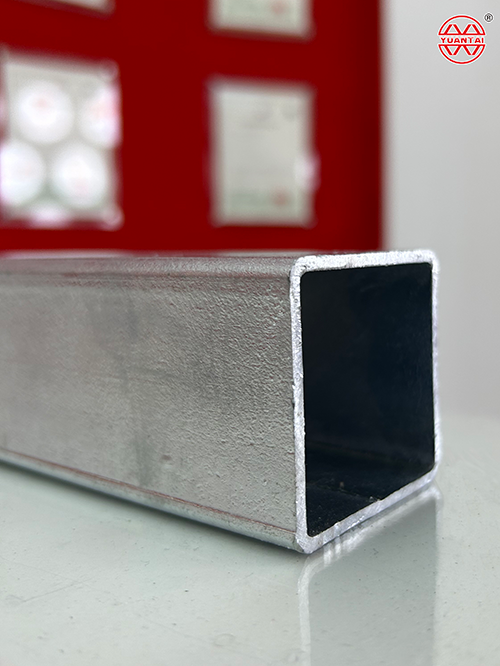
Table 2: Rectangular Tubes — Bending About the Strong Axis
Size (mm) | Wall (mm) | Weight (kg/m) | I (cm⁴) | S (cm³) |
|---|---|---|---|---|
100×50 | 4.0 | 8.92 | 144.1 | 28.8 |
120×60 | 5.0 | 13.35 | 309.4 | 51.6 |
150×100 | 5.0 | 18.84 | 754.5 | 100.6 |
200×100 | 6.0 | 27.13 | 1,793.9 | 179.4 |
For a rectangular tube, bending about the strong axis means bending about the axis associated with the larger section depth.
For example, a 100×50 section has considerably greater I about the axis associated with its 100 mm depth than about the perpendicular axis.
This makes RHS useful when the primary bending direction is known and the available structural depth is important.
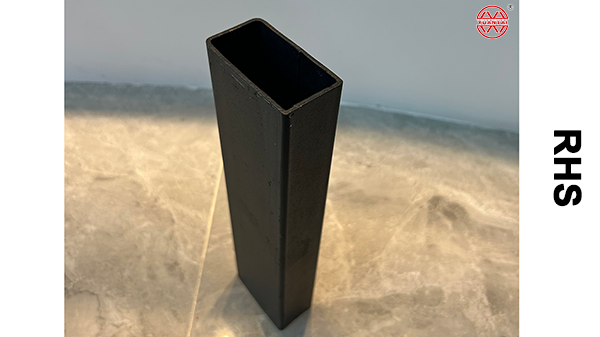
Table 3: Round Pipe vs. Square Tube — Similar Outside Size
Section | Weight (kg/m) | I (cm⁴) | Stiffness per kg (cm⁴/kg) |
|---|---|---|---|
Round pipe Ø100×4 | 9.47 | 139.2 | 14.7 |
Square tube 100×100×4 | 12.06 | 236.3 | 19.6 |
Round pipe Ø114×4 | 10.85 | 209.3 | 19.3 |
These examples show that a square section can provide high bending stiffness about its principal axes for a similar nominal outside size and wall thickness.
The comparison should not be interpreted as a universal ranking between round and square sections. The best shape depends on the loading direction, weight target, buckling requirements, connections, torsional demands, and application.
Round pipe has the same bending properties about any centroidal axis. That can be useful for columns or structures where load direction varies. Its circular geometry also makes it particularly suitable for fluid transport.
Worked Example 1: Checking Deflection in 3 Steps
Question: A 100×100×4 mm square tube spans 6 m as a simply supported beam with a 2,000 N point load at midspan. Assume a steel elastic modulus of E = 200,000 MPa and, for this example only, a deflection limit of L/300 = 20 mm.
Step 1 — Read the Section Properties
From Table 1:
I = 236.3 cm⁴ = 2.363 × 10⁶ mm⁴
S = 47.3 cm³ = 4.73 × 10⁴ mm³
Step 2 — Check Deflection
For a simply supported beam with a central point load:
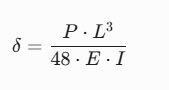
Substituting:
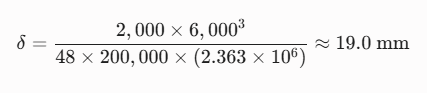
Assumed limit:20 mm
So the section is just within the assumed deflection limit.
The actual allowable deflection depends on the applicable design code and project requirements; L/300 is used here only as an illustrative assumption.
Step 3 — Check Bending Stress
The maximum bending moment is:

Bending stress:
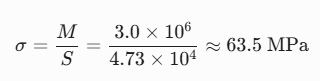
For illustration, if a nominal yield strength of 315 MPa is assumed:
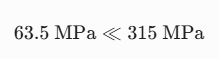
The calculated elastic bending stress is well below the assumed yield strength. In this simplified example, deflection is much closer to its assumed limit than the bending stress is to yield.
That illustrates why a beam can satisfy a basic strength check while still requiring attention to stiffness.
If greater stiffness were required, increasing the overall section size can be an efficient option. For example, a 120×120×5 section has a much higher calculated I than the 100×100×4 section.
Worked Example 2: Same Weight, Bigger Section Wins
Consider two square tubes with similar nominal material weight:
Option | Weight (kg/m) | I (cm⁴) | Comparison |
|---|---|---|---|
A: 80×80×6 | 13.94 | 163.2 | Baseline |
B: 100×100×4 | 12.06 | 236.3 | 13% lighter, 45% higher I |
In this simplified comparison, the 100×100×4 section provides substantially greater bending stiffness with lower nominal weight.
The reason is that increasing the overall section depth moves more of the steel farther from the neutral axis.
However, this principle has a practical limit. A thinner wall may have different local buckling or slenderness behavior, and the applicable design standard must still be checked.
So when comparing tube options, do not compare price per tonne alone. For structural applications, it can be useful to compare:
I per kg
and, where strength is important:
S per kg
along with the relevant buckling and design requirements.
How to Specify Section Properties When Ordering
When requesting a quotation or ordering steel hollow sections, give the supplier enough information to identify the required section and design basis.
Specify the Standard
State the applicable standard, such as:
ASTM A500
EN 10219
GB/T 6728-2025
Also specify the required steel grade where applicable.
State the Size and Wall Thickness
Give the exact section dimensions, for example:
100×100×4 SHS
or:
4×4×0.157 in.
Do not rely on nominal outside dimensions alone when the project has specific wall-thickness or tolerance requirements.
Request Material Documentation
The MTC (Mill Test Certificate) primarily confirms the supplied material against the specified requirements, such as steel grade, chemical composition, mechanical properties, and applicable standard requirements.
Section properties such as I and S are geometric properties. For standard sections, they can normally be calculated from the specified dimensions or taken from applicable section-property tables.
If you are purchasing a non-standard or rolled-to-order section, ask the supplier to provide the calculated section properties and the basis used for the calculation.
For important structural applications, it is also worth confirming whether the published properties account for corner radii, nominal or actual dimensions, and the design standard being used.
FAQ
Q1:What is the moment of inertia of a steel tube?
The moment of inertia, or second moment of area, is a geometric property that describes how the material is distributed around a bending axis. It is commonly expressed in cm⁴ or in⁴ and is used in stiffness and deflection calculations.
For a simplified square tube:
I = (a⁴ − b⁴) / 12
For a round pipe:
I = π(D⁴ − d⁴) / 64
For a given geometry, I does not depend on the steel grade.
Q2:What is the section modulus of a pipe?
Section modulus is:
S = I/c
where c is the distance from the neutral axis to the outermost fiber.
It is commonly expressed in cm³ or in³ and is used to calculate bending stress:
σ = M/S
Q3:What is the difference between moment of inertia and section modulus?
Moment of inertia (I) is primarily a measure of cross-sectional bending stiffness and is used in deflection calculations.
Section modulus (S) relates the cross-sectional geometry to bending stress and is used in strength checks.
The same tube can therefore have one I value and one S value for a particular bending axis, but the two properties answer different engineering questions.
Q4:Why is a hollow tube efficient compared with a solid bar?
For a given amount of steel, a hollow section can achieve high bending stiffness by distributing more of its material away from the neutral axis.
The benefit depends on the section geometry and the bending axis. A hollow section is not automatically the best choice for every loading condition, but efficient material distribution is one of the main reasons SHS, RHS, and CHS are widely used in structural applications.
Q:How do I calculate section modulus for a rectangular tube?
For a simplified rectangular hollow section:
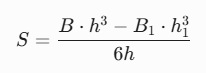
where B×h are the outside dimensions and B₁×h₁ are the inside dimensions.
For standard sections, using published section-property tables can be faster and more reliable than recalculating every value manually.
Conclusion
Moment of inertia and section modulus translate a steel tube's geometry into useful engineering properties.
I is primarily used when evaluating bending stiffness and deflection.
S is used to relate bending moment to bending stress.
For many structural tube comparisons, increasing the overall section depth can produce a significant increase in I without a proportional increase in weight. But wall thickness still matters for strength, local buckling, tolerances, connections, durability, and code compliance.
That is why section selection should go beyond OD × wall thickness or price per tonne.
If you are specifying SHS or RHS for a project, compare the required I and S with the loading and design criteria before placing the order.
Need help selecting the right steel tube? Send us your required section size, wall thickness, steel grade, standard, quantity, and application. Our technical team can help confirm the available section and provide the relevant product and section-property information with your quotation.