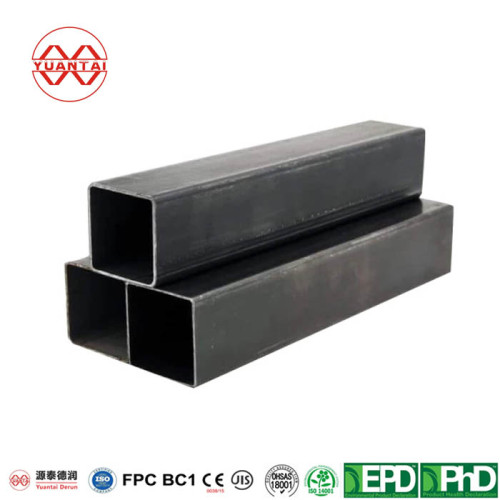

Large-Size SHS/RHS: Engineering Heavy Structural Steel
Large-Size SHS/RHS: Engineering Heavy Structural Steel
Beyond Standard Tubing: The "Jumbo" Reality
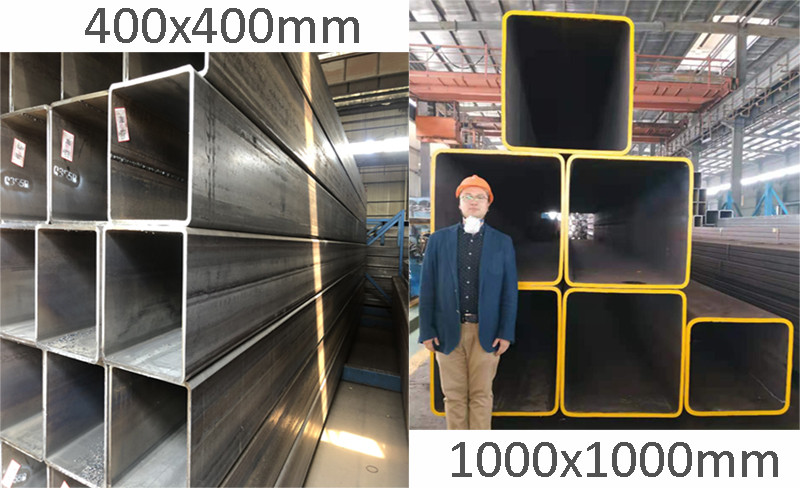
In the high-stakes world of heavy structural steel, the term "Large-Size" represents a fundamental shift in load-bearing philosophy. We are specifically discussing Jumbo SHS and Large-size RHS with side lengths starting at 300mm and scaling up to a staggering 1200mm.
While standard structural steel tubing might suffice for a warehouse frame, these heavy-wall sections—often reaching 50mm in thickness—are the indispensable "skeletons" of 100-story mega-towers, expansive airport terminals, and offshore wind foundations. The move toward jumbo sections isn't just about scale; it’s about replacing clusters of smaller beams with a single, high-efficiency hollow member that offers a superior strength-to-weight ratio.
The Technical Benchmark: Precision Overpowers Scale
Manufacturing a 1000mm square tube is a masterclass in metallurgy. Unlike smaller pipes, the internal physics of a jumbo section change during the bending process. The real industry "gatekeeper" is R-angle control.
The Stress Factor: A corner that is too sharp triggers strain aging and micro-cracking, which can lead to catastrophic failure under dynamic loads.
Advanced Forming Processes: To achieve the elite 2.0t to 3.0t radius on a 40mm thick wall, top-tier mills have abandoned standard presses in favor of the JCOE process or Circle-to-Square forming. This specialized sequence manages residual stress far better than budget-grade cold-bending. For the engineer, this means the tube won't "spring back" or warp during critical on-site welding or precision laser cutting.
Global Standard Wars: S355J2H vs. ASTM A500
Sourcing these behemoths requires navigating a complex "alphabet soup" of international specifications. Each standard dictates a different structural ceiling:
The European Edge (EN 10219): This is the gold standard for brutal environments. Grades like S355J2H are mandatory for North Sea jackets because they guarantee high-impact toughness at sub-zero temperatures (-20℃).
The North American Preference (ASTM A500 & A1085): While A500 Grade C is common, the newer ASTM A1085 is gaining traction. What sets it apart for heavy infrastructure is the predictability of its mass and energy absorption. The mandatory Charpy V-notch verification isn't just a hurdle—it’s a guarantee of ductility for complex bridge geometries. This tighter control over material variance directly translates to more reliable welding and long-term structural integrity.
| Parameter | ASTM A500 (Product Specification) | ASTM A1058 (Testing Methodology) |
| Standard Type | Material/Product Standard | Mechanical Testing Standard |
| Primary Function | Defines "What" the steel must be (requirements). | Defines "How" to test the steel (procedures). |
| Chemical Composition | Mandatory limits for Carbon, Manganese, Phosphorus, Sulfur, and Copper. | No requirements; chemical analysis is not covered in this standard. |
Mechanical Property Limits | Specified minimums for Yield Strength, Tensile Strength, and Elongation. | No limits specified; provides the method to measure these values. |
Dimensional Tolerances | Defines limits for wall thickness, outside diameter, flatness, and R-angle (corner radius). | Not applicable; does not define product dimensions. |
Unit System | Primarily Inch-Pound (with metric equivalents as reference). | Specialized for Metric (SI) Units. |
Testing Scope | Specifies which tests are required (e.g., Flattening test, Tension test). | Provides the technical procedure for Tension, Impact, Bend, and Hardness tests. |
Specimen Preparation | Defines the location of the test sample (e.g., opposite the weld seam). | Defines the exact metric dimensions and geometry of the test bars/coupons. |
Yield Point Determination | Mandates the minimum stress level (e.g., 46 ksi for Grade B). | Details the "Offset Method" or "Extension Under Load" calculation procedures. |
The Seismic Factor:For infrastructure in seismic hotspots, standard steel often lacks the necessary energy dissipation capacity. The industry standard has shifted toward BCR/BCP and ASTM A1085 specifications, which prioritize ductility over raw hardness. These grades are optimized to allow for plastic hinge formation in the column-beam joints, ensuring the building remains standing even after significant structural displacement.
Field-Proven Applications: Why Square Beats H-Beams
A common question in B2B procurement is: Why lug a massive, expensive heavy-wall RHS to a job site when H-beams are cheaper? The answer lies in Torsional Rigidity. A closed hollow section resists twisting and lateral-torsional buckling far better than an open I-beam.
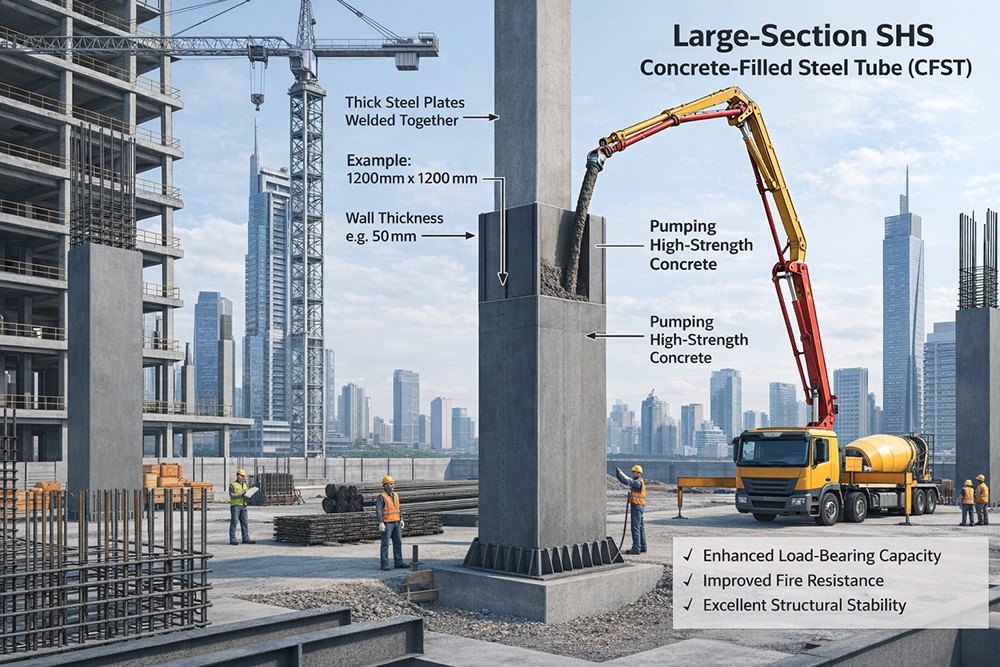
Composite Power (CFT Columns): Modern skyscrapers utilize these jumbo tubes as permanent, high-strength formwork. By pumping high-strength concrete into a 1200mm SHS, engineers create a Concrete-Filled Tube column. This composite member provides world-class axial load capacity, reduced column footprint, and natural fire resistance without the need for thick intumescent coatings.
Long-Span Infrastructure: In airport terminals and stadiums, the clean lines of SHS allow for "tree-column" designs that handle massive roof loads while maintaining an aesthetic, minimalist look.
The Corrosion Game-Changer: For coastal or industrial projects, the industry is seeing a total pivot toward Zinc-Magnesium-Aluminum (ZMA) coatings. Unlike traditional hot-dip galvanizing, ZMA coating offers a "self-healing" property. If the tube is scratched or cut during installation, the magnesium in the coating migrates to protect the exposed steel. This is a massive win for modular construction where maintenance access is often restricted.
Future Trends: Digital Passports and ROI
The future of modern steel construction is increasingly data-driven. We are moving toward a "Digital Passport" system for every Jumbo SHS. By scanning a QR code on the mill surface, a site engineer can instantly access the CEV value, heat numbers, and UT reports.
Furthermore, as global focus shifts to Green Steel, the efficiency of jumbo sections becomes a key ROI driver. Using one large RHS instead of multiple smaller reinforced beams reduces the total tonnage of the project, lowering the overall carbon footprint while speeding up the assembly timeline in modular construction.
Conclusion
The evolution of Large-size SHS/RHS represents the pinnacle of current steel manufacturing. It is a material that rewards precision and penalizes shortcuts. For developers and engineers, choosing the right mill—one that understands the nuances of R-angle integrity and S355J2H toughness—is the single most important factor in ensuring the longevity of our modern built environment.
1.Why is R-angle control so critical in Jumbo SHS manufacturing?
In heavy-wall sections , the R-angle dictates stress distribution. An R-angle that is too sharp causes strain aging and micro-cracking during the cold-forming process. Precision control ensures the section can handle dynamic seismic loads without catastrophic failure.
2.How does a CFT column improve skyscraper safety?
Concrete-Filled Tube columns utilize the Jumbo SHS as a permanent formwork. The steel tube confines the concrete, increasing its compressive strength, while the concrete core prevents the steel from buckling locally. This synergy provides world-class axial load capacity and natural fire resistance.
3.What is the difference between ASTM A500 and ASTM A1058?
ASTM A500 is the Product Standard that sets the requirements for the steel itself (grades, chemistry, strength). ASTM A1058 is the Testing Standard used primarily for international metric projects; it provides the specific procedures for how mechanical tests should be conducted in SI units.
4.Why choose ZMA over traditional galvanizing?
ZMA coatings offer a unique "self-healing" property. When the steel is cut or scratched during installation, the magnesium migrates to form a protective film over the exposed area. This is essential for coastal infrastructure and modular construction where maintenance is difficult.
5.What is a "Digital Passport" in structural steel?
It is a data-driven traceability system where a QR code on the Jumbo SHS provides instant access to Heat Numbers, CEV values, UT reports, and mill certificates. This ensures 100% transparency for site engineers and safety inspectors.