
The Steel Pipe Standard Maze: A Practical Guide to ASTM, ASME, API & ANSI
The Steel Pipe Standard Maze: A Practical Guide to ASTM, ASME, API & ANSI
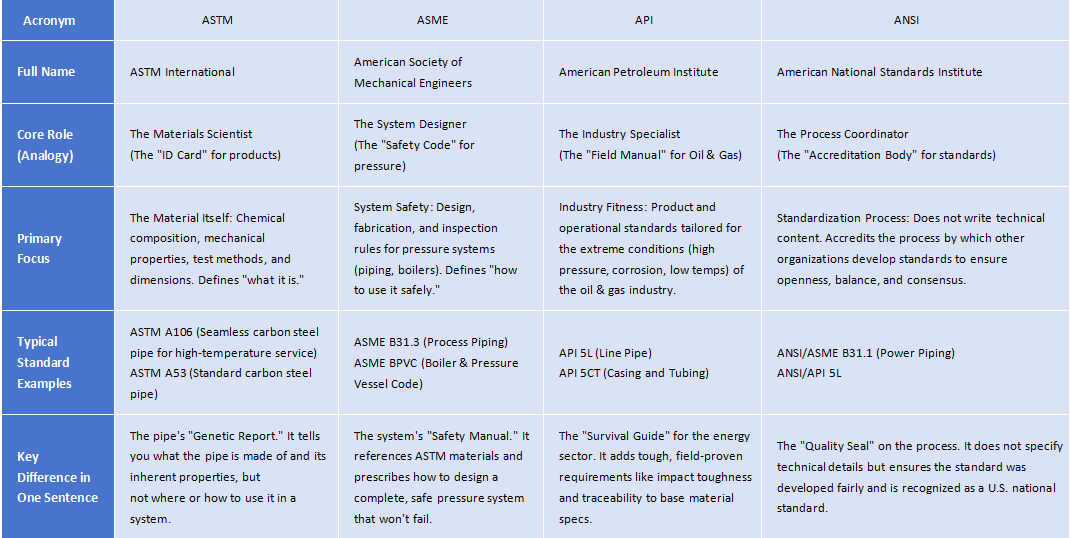
If you've ever ordered steel pipe and been asked, “Do you need it to ASTM, ASME, or API spec?” only to reply, “Um, just give me the strong stuff,” you’re not alone. The alphabet soup of piping standards is a classic source of confusion in engineering and construction. But here’s the thing: these aren't just bureaucratic labels. They're a precise language that ensures a pipe in a chemical plant in Texas has the same reliability as one in a skyscraper in Dubai.
Mixing them up isn't a paperwork error—it's a fundamental engineering mistake. Let's cut through the jargon and break down what these four key organizations really do, using plain language and a few hard-won lessons from the field.
The Quick Analogy
Imagine building a car:
ASTM specifies the grade of the steel for the frame and the rubber for the tires.
ASME designs the braking system and sets the pressure limits for the coolant lines.
API sets the rules for the off-road suspension kit meant for the Baja 1000.
ANSI is the organizer who made sure all those other rulebooks were written by a committee of experts, not just one company.
They work together, but you wouldn’t use the off-road suspension specs to build a city bus.
ASTM International: The Material Scientist
What they do: ASTM is all about the “what.” What is this pipe made of? What are its innate properties?
Chemical Composition: How much carbon, manganese, or chromium is in this steel?
Mechanical Properties: What’s its yield strength, tensile strength, and elongation?
Testing Methods: Exactly how do we test and verify those properties?
Dimensional Tolerances: What are the allowable variations in outer diameter and wall thickness?
In Practice: When you see ASTM A106 or ASTM A53, you’re looking at a material specification sheet. It tells you the pipe’s DNA. An engineer uses this to select a pipe grade suitable for its environment (e.g., A106 Grade B for high-temperature service). Crucially, ASTM does not tell you how much pressure that pipe can hold in a system. It just tells you the raw material’s capabilities.
Key Takeaway: ASTM defines the ingredients. It’s your first and most fundamental selection.
ASME: The System Designer
What they do: ASME is all about the “how.” How do you safely assemble those ASTM materials into a pressurized system?
Design Rules: Formulas for calculating minimum required wall thickness under pressure.
Allowable Stresses: The maximum stress you can safely apply to an ASTM material in service (always lower than its yield strength!).
Fabrication & Inspection: Rules for welding, bending, testing, and inspecting the completed system.
Safety Factors: The built-in margins that account for unknowns.
In Practice: The ASME Boiler & Pressure Vessel Code (BPVC) and the ASME B31 Pressure Piping Code (e.g., B31.1 for power plants, B31.3 for process plants) are the bibles here. They reference ASTM materials (e.g., “Use ASTM A106 Gr. B”) and then dictate how to use them. ASME essentially says: “Okay, you've chosen A106 pipe. Now, for your design pressure of 500 psi, here's exactly how thick it needs to be, how to weld it, and how to prove it’s safe.”
Key Takeaway: ASME provides the blueprint and safety protocol for the entire system.
API: The Oil & Gas Specialist
What they do: API tailors standards for the extreme demands of the oil and gas industry. They blend material and design requirements with rugged, field-focused performance needs.
Fitness-for-Service: Standards built for sour service (H2S), low temperatures, and high-pressure fluctuations.
Toughness Requirements: Mandating impact tests to ensure pipes don’t brittle fracture.
Traceability: Strict requirements for tracking a pipe from mill to installation.
Field Operations: Covering everything from drill pipe to pipeline transportation.
In Practice: API 5L for line pipe is the world’s premier pipeline specification. While it looks like an ASTM material spec, it includes additional, industry-specific requirements for toughness, testing, and end-finish that ASTM might not. API standards are often the contract-mandated rules for pipelines, refineries, and offshore platforms.
Key Takeaway: API writes the specialized survival manual for the world’s most demanding energy environments.
ANSI: The Process Referee
What they do: ANSI doesn’t typically write technical standards. It accredits the process by which other organizations (like ASME and API) develop them.
Ensures Consensus: Requires an open, balanced committee from various interest groups (manufacturers, users, regulators).
Due Process: Guarantees that everyone gets a fair say and that appeals are possible.
U.S. Representation: Serves as the U.S. voice in international standards bodies (like ISO).
In Practice: When you see ANSI/ASME B31.3, it means the ASME B31.3 code was developed under ANSI’s accredited procedures, giving it greater legitimacy and wide acceptance as an “American National Standard.”
Key Takeaway: ANSI is the quality seal on the standard-making process itself, ensuring it’s fair and nationally recognized
How They Interact on a Real Project: A Pipeline Example
Let's say you're building a natural gas pipeline:
1.Material Procurement: You specify pipe to API 5L PSL2, Grade X70. This API standard incorporates the material fundamentals of an ASTM spec but adds the extra toughness and testing the industry requires.
2.System Design: You design the pipeline pressure loops and pumping stations according to ASME B31.8, which governs gas transmission piping. This code will tell you how to use your API 5L pipe in a safe system.
3.Process Assurance: The development of both the API 5L and ASME B31.8 standards likely followed ANSI-accredited procedures, meaning industry-wide consensus was reached.
4.Foundation: Underlying everything are the fundamental test methods defined by ASTM that everyone uses to verify properties.
The Bottom Line for Engineers & Buyers
Start with the System Code (ASME/API). Don't start with the material. First, determine the governing code for your application (Is it a process plant? A building sprinkler? A subsea pipeline?). That code will tell you which material specs (ASTM/API) are acceptable.
ASTM vs. API for Material? If you're in oil & gas, the contract will almost always mandate API. For general industrial or construction applications, ASTM is common. API specs are often seen as more comprehensive for critical service.
ANSI in the Background. You don't usually “choose” ANSI. You choose a standard that carries ANSI accreditation, which gives you confidence in its integrity.
Final Thought: Specifying the wrong standard is like ordering parts for a diesel truck when you're building a sports car. They might both be vehicles, but the failure modes are catastrophic. Understanding the distinct roles of ASTM, ASME, API, and ANSI isn't academic—it's the bedrock of safe, reliable, and interoperable industrial infrastructure. When in doubt, consult the system design code first; it holds the map to the rest of the maze.