
How Straight Is Black Steel Pipe? ASTM A53 Tolerance Guide
A buyer on a metalworking and DIY machinery forum recently asked a simple question:
“How straight is black steel pipe usually? I have a DIY project where straightness is important. I’d be curious what kind of tolerance these pipes are made to. Specifically interested in concentricity and straightness.”
It is a reasonable question, especially when a piece of black steel pipe is going into a machine frame, workbench, roller assembly, or another project where alignment matters.
The short answer is that black steel pipe is not normally manufactured as precision shafting.
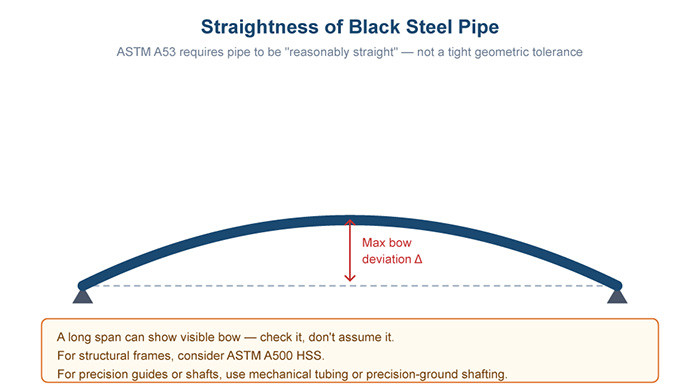
ASTM A53/A53M covers welded and seamless black steel pipe for mechanical and pressure applications. The current ASTM A53/A53M-24 specification states that finished pipe shall be “reasonably straight.” It also specifies dimensional requirements such as outside diameter and minimum wall thickness.
That is different from specifying a tight geometric tolerance for use as a precision guide or shaft.
So, how straight is black steel pipe?
The answer depends on the pipe size, wall thickness, manufacturing process, length, and the dimensional requirements that apply to the product. If straightness or concentricity is critical, it is better to specify the required geometry rather than assume that standard pipe will behave like precision tubing.
Table of Contents
· Quick Answer: How Straight Is Black Steel Pipe?
· What Does “Reasonably Straight” Mean in ASTM A53?
· ASTM A53 Dimensional Tolerances
· Wall Thickness, Concentricity and Ovality
· Does ERW Black Pipe Have Good Concentricity?
· ASTM A53 Pipe vs. ASTM A500 Structural Tubing
· How to Check Black Steel Pipe Straightness
· Is Black Steel Pipe Suitable for CNC or Linear Motion?
· Frequently Asked Questions
· Final Takeaway
1. Quick Answer: How Straight Is Black Steel Pipe?
For ordinary black steel pipe made to ASTM A53, there is no single universal “0.2% straightness tolerance” that should be applied to every A53 pipe.
ASTM A53 states that finished pipe shall be reasonably straight. The standard also controls dimensions such as outside diameter and wall thickness, but those requirements are intended for pipe applications rather than precision shafting.
In practical terms:
ASTM A53: covers welded and seamless black steel pipe, with the same specification also covering hot-dipped galvanized pipe.
Straightness: the finished pipe shall be reasonably straight; some suppliers use experience-based formulas (for example, maximum bow ≤ 0.030 in × length(ft) / 5), but these are not uniform mandatory tolerances in the ASTM standard itself.
Outside diameter: subject to specified dimensional tolerances (typically ±1% for NPS 2 and larger; ±1/64 in for NPS 1½ and smaller).
Wall thickness: subject to a minimum wall thickness requirement (commonly not more than 12.5% below the specified wall at any point).
Concentricity: A53 does not provide a simple general concentricity tolerance comparable to precision mechanical tubing.
Precision guide applications: require closer attention to straightness, roundness, concentricity and surface requirements.
A pipe can therefore conform to ASTM A53 and still be unsuitable for a long linear guide, precision shaft, or close-fitting mechanical assembly.
That distinction is important.
2. What Does “Reasonably Straight” Mean in ASTM A53?
The phrase “reasonably straight” can sound vague to someone accustomed to machining tolerances.
But ASTM A53 is not intended to function as a precision shafting specification. Its scope covers seamless and welded black and hot-dipped galvanized steel pipe, including Type E electric-resistance-welded and Type S seamless pipe. ASTM describes the pipe as intended for mechanical and pressure applications and for ordinary steam, water, gas and air lines.
The workmanship section of ASTM A53/A53M-24 states:
“The finished pipe shall be reasonably straight.”
This does not mean that manufacturers can supply severely bent pipe without limitation. ASTM A53 also contains dimensional and workmanship requirements that finished pipe must meet.
However, it does mean that you should not automatically convert “reasonably straight” into a universal percentage of total length. Some manufacturers and distributors use internal straightness controls or empirical formulas, but these are not the same as a single ASTM-wide straightness tolerance.
Why This Matters
Consider two applications.
Pipe used for a water line
A small amount of bow over a long length may have little practical effect. The pipe is installed with fittings, supports and hangers, and its main function is to contain and transport fluid.
Pipe used as a linear motion rail
The same amount of bow can become a major problem. A bearing or carriage following a long pipe may bind, develop uneven contact, or require additional adjustment.
The material has not necessarily failed its pipe specification. The issue is that the application requires a different level of geometric control.
3. ASTM A53 Dimensional Tolerances
Straightness is only one part of pipe geometry.
When evaluating black steel pipe, it is also useful to distinguish between outside diameter, wall thickness, ovality and concentricity.
| Parameter | ASTM A53 Consideration |
| Straightness | Finished pipe shall be reasonably straight; no single universal numerical tolerance in the standard. Some suppliers use empirical rules (e.g., max bow ≈ 0.030 in × L(ft)/5), but these are not ASTM-mandated for all A53 pipe. |
| Outside diameter | Dimensional tolerances apply. Typically ±1% for NPS 2 (DN 50) and larger; ±1/64 in (≈0.4 mm) for NPS 1½ (DN 40) and smaller. |
| Wall thickness | Minimum wall thickness requirement applies (commonly not more than 12.5% below specified wall at any point). |
Concentricity | No simple general concentricity tolerance is specified. |
Ovality | Dimensional requirements limit OD variation, but A53 is not a precision roundness specification. |
For ASTM A53/A53M-24, the outside diameter for NPS 2 [DN 50] and larger is not permitted to vary more than ±1% from the specified outside diameter. For NPS 1½ [DN 40] and smaller, the specified OD tolerance is ±1/64 in [0.4 mm]. The minimum wall thickness at any point cannot be more than 12.5% below the specified wall thickness.
These are important dimensional controls, but they should not be confused with a precision mechanical tubing specification.
A Useful Distinction
Dimensional tolerance tells you how much a particular dimension may vary.
Straightness describes deviation along the length.
Concentricity describes the relationship between the inner and outer cylindrical surfaces.
Ovality describes how far the cross-section departs from a true circle.
They are related, but they are not interchangeable.
4. Wall Thickness, Concentricity and Ovality
These three terms are often mixed together when people discuss pipe geometry.
Wall Thickness Variation
Wall thickness variation describes how much the wall changes from one location to another.
For example, one side of a pipe may have slightly more material than the opposite side.
ASTM A53 controls minimum wall thickness, but a minimum-wall requirement should not be interpreted as a direct concentricity tolerance.
Concentricity
Concentricity describes how closely the inner and outer cylindrical surfaces share the same center.
A pipe can have an acceptable outside diameter while the inside surface is not perfectly centered.
This matters more when the pipe is being used for:
· close-fitting sleeves;
· rotating components;
· bearing surfaces;
· mechanical assemblies;
· precision alignment.
If concentricity is critical, it should be defined in the purchasing or engineering specification, along with an inspection method (for example, ultrasonic thickness mapping or multi-point measurements around the circumference).
Ovality
Ovality, or out-of-roundness, describes how much the cross-section differs from a true circle.
A pipe may have a diameter that falls within its applicable dimensional tolerance while still not being perfectly round.
For general piping applications, this may have little practical significance. For a close-fitting mechanical component, it can become important.
Straightness Is a Separate Issue
A pipe can have a reasonably round cross-section but still be bowed along the length.
Conversely, a pipe can be relatively straight while having local dimensional variation.
That is why straightness, roundness and concentricity should be treated as separate inspection characteristics when a mechanical application requires them.
5. Does ERW Black Pipe Have Good Concentricity?
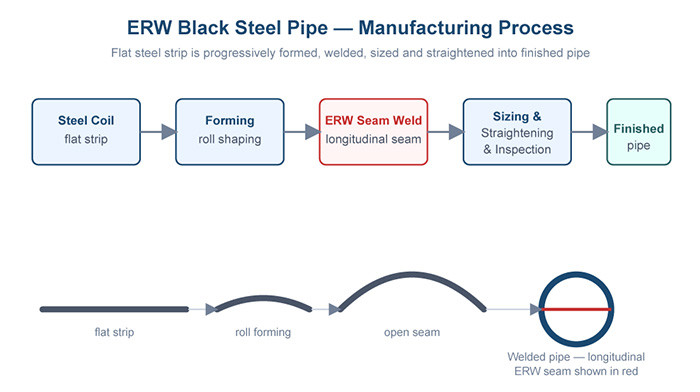
A large amount of commercial black steel pipe is produced by the Electric Resistance Welding (ERW) process.
The basic process is:
Steel coil → Roll forming → ERW welding → Sizing → Finished pipe
The pipe starts as flat steel strip. Forming rolls progressively shape the strip into a cylindrical section, and the longitudinal edges are joined by resistance welding.
Because the starting strip is produced with controlled thickness, ERW manufacturing can provide good consistency in the starting material.
But this does not mean that every finished ERW pipe has perfect wall uniformity or concentricity.
Final geometry can be influenced by:
strip thickness variation;
forming conditions;
welding;
sizing;
pipe diameter;
wall thickness;
straightening;
handling after production.
So it is more accurate to say that ERW can provide consistent pipe geometry when properly manufactured, rather than assuming that ERW pipe is automatically more concentric than seamless pipe.
If a project has strict concentricity requirements, specify them explicitly and agree on inspection methods with the supplier instead of relying on “ERW vs. seamless” as a proxy for concentricity.
6. ASTM A53 Pipe vs. ASTM A500 Structural Tubing
If the application is structural rather than pressure-containing, ASTM A500 structural tubing may be a more appropriate starting point.
ASTM A500/A500M covers cold-formed welded and seamless carbon steel structural tubing in round, square and rectangular shapes.
The important point is not that A500 is a precision tube. It is that the specification is designed around structural hollow sections, with dimensional and mechanical requirements intended for structural applications.
| Feature | ASTM A53 Pipe | ASTM A500 Structural Tubing |
| Main application | Mechanical and pressure applications (fluid lines, general mechanical use) | Structural applications (frames, supports, columns) |
| Common shapes | Round pipe | Round, square, rectangular |
| Straightness | “Reasonably straight” (no single universal numerical tolerance in ASTM) | Numerical straightness requirement: ≤ 1/8 in × total length (ft) / 5 |
Typical uses | Fluid lines and mechanical applications | Frames, supports and structures |
Precision shafting | Not intended | Not intended |
ASTM A500/A500M-23 specifies the permissible straightness variation as 1/8 in multiplied by the number of feet of total length and divided by 5, which is equivalent to about 0.025 in per foot of length.
That is a requirement specific to A500 structural tubing and should not be transferred to ASTM A53.
What About Machinery Frames?
For a welded machinery frame, A500 can make sense when the required dimensions, strength and structural properties match the design.
Square and rectangular HSS also provide flat faces that can be convenient for welding brackets, plates and mounting components.
For a precision linear guide, bearing shaft or sliding rail, however, A500 should not automatically be treated as the solution.
Those applications may call for mechanical tubing, cold-drawn tubing, precision-ground shafting or another product specifically manufactured for the required geometric tolerances.
Need Structural HSS?
If you are sourcing round, square or rectangular hollow sections for structural fabrication, see our [Structural Hollow Section range →].
7. How to Check Black Steel Pipe Straightness
If you already have black steel pipe and want to find the straightest length, a few simple checks can help.
Method 1: Straightedge Check
Place the pipe against a known straight reference, such as a suitable precision straightedge or flat reference surface.
Check several positions along the length rather than inspecting only the ends.
This gives you a quick indication of overall bow and local deviations.
Method 2: Roll Test
Place the pipe on a reasonably flat surface and rotate or roll it slowly.
A pipe that rocks or repeatedly changes contact points may have dimensional irregularities.
However, this test cannot by itself tell you whether the problem is straightness, ovality, local deformation or another geometric variation.
Use it as a screening method rather than a dimensional inspection.
Method 3: Dial Indicator
For a more useful measurement, support the pipe appropriately and run a dial indicator along the surface while rotating or translating the pipe.
Record the maximum and minimum readings and document the test setup.
For a meaningful result, note:
pipe outside diameter;
wall thickness;
test length;
support spacing;
indicator position;
measurement direction;
maximum deviation.
This is much more useful than simply saying that a pipe “looks straight.”
8. Is Black Steel Pipe Suitable for CNC or Linear Motion?
It depends on the required accuracy.
For a basic DIY structure, workbench, rack or general-purpose frame, ordinary black pipe can work well.
For a CNC router or plasma table, the answer depends on the design and the required accuracy. A pipe may be perfectly adequate for a low-cost system while being unsuitable for a machine designed for tighter positional tolerances.
Linear motion systems are less forgiving.
If bearings, bushings or rollers must travel along the pipe, geometric variation can affect:
smooth movement;
preload;
alignment;
bearing contact;
For higher-precision motion systems, purpose-made mechanical tubing or ground shafting is generally a better choice than ordinary black pipe.
A Simple Application Guide
| Application | Is Black A53 Pipe a Reasonable Choice? |
| Workbench | Generally suitable |
| Shelving | Generally suitable |
| Shop cart | Generally suitable |
Structural frame | Depends on design and stiffness requirements |
CNC frame | Depends on stiffness and accuracy requirements; often acceptable for light-duty machines |
Linear guide | Usually not the first choice; consider mechanical tubing or ground shafting for higher precision |
Precision shaft | Not intended |
Fluid piping | Use the applicable pipe specification (A53 or other) |
The key question is not simply “Is black pipe straight?”
It is:
“Is it straight enough for the tolerance required by the application?”
As a rule of thumb:
If your system can tolerate visible bow and does not rely on tight sliding fits, A53 black pipe is often fine.
If you need repeatable positioning in the 0.1–0.2 mm range or smooth low-friction travel over long distances, choose mechanical tubing or precision ground shafting instead.
9. Frequently Asked Questions
Q:What is the straightness tolerance of ASTM A53 pipe?
A:ASTM A53 states that finished pipe shall be “reasonably straight.” The standard should not be reduced to a universal 0.2% straightness formula for all A53 pipe.
Some suppliers use internal straightness controls or empirical rules (for example, maximum bow ≈ 0.030 in × length(ft) / 5), but these are not uniform ASTM-mandated tolerances. If a project requires a specific straightness tolerance, that requirement should be defined separately in the purchasing or engineering specification.
Q:Is black steel pipe good for a guide rail?
A:Black steel pipe may work for some low-precision DIY applications, but ordinary ASTM A53 pipe is generally not intended as precision guide-rail material.
Higher-precision systems may require mechanical tubing or precision-ground shafting with defined straightness, roundness and surface requirements.
Q:Is ERW pipe concentric?
A:ERW pipe can have good dimensional consistency, but ERW manufacturing does not guarantee perfect concentricity.
Wall-thickness variation, forming, sizing and other manufacturing factors can affect the relationship between the inside and outside surfaces. If concentricity is critical, specify it explicitly and agree on inspection methods with the supplier.
Q:Is A500 tubing straighter than A53 pipe?
ASTM A500 includes a numerical straightness requirement for structural tubing (≤ 1/8 in × length(ft) / 5, ≈ 0.025 in/ft), while ASTM A53 uses a “reasonably straight” workmanship requirement without a single universal numerical tolerance.
A500 structural tubing is not, however, a precision shafting product.
Q:Can I use A53 pipe for a CNC machine frame?
A:A53 pipe can be used in some CNC frame designs, depending on the required stiffness, section size, wall thickness, span and machine accuracy.
ASTM A500 structural tubing may also be considered when its requirements match the application, especially for square or rectangular frames where flat faces simplify welding and mounting.
Need ASTM A53 Black Steel Pipe?
If you are sourcing ASTM A53 black steel pipe for a project, send us your required size, wall thickness, length, quantity and applicable standard. We can review the specification and provide a quotation based on your requirements.
[Contact Yuantai Derun for a Quote →]
10. Final Takeaway
Black steel pipe can be an excellent material for many general fabrication and piping applications. But black steel pipe should not be treated as a precision geometric product simply because it is manufactured to an industrial standard.
For ASTM A53, the standard states that finished pipe shall be reasonably straight and provides dimensional requirements for characteristics such as outside diameter and wall thickness. It does not turn ordinary pipe into precision shafting.
The right choice depends on what the steel needs to do:
Fluid service: select a pipe specification such as ASTM A53 when it meets the design and service requirements.
Structural frames and supports: ASTM A500 structural tubing may be a better fit when its dimensional and mechanical requirements match the application.
Precision linear guides or shafts: use tubing or shafting specifically manufactured for the required straightness, roundness, concentricity and surface requirements.
If straightness matters to the project, do not rely on appearance alone.
Define the required tolerance, inspect the material, and select the product specification around the actual application.
Looking for Structural Hollow Sections?
Yuantai Derun supplies round, square and rectangular structural hollow sections for a range of structural and fabrication applications.
[View Our Structural Hollow Section Range →]
Need Black Steel Pipe or Custom Sizes?
Tell us your required specification, dimensions, length and quantity.
[Contact Yuantai Derun for a Quote →]