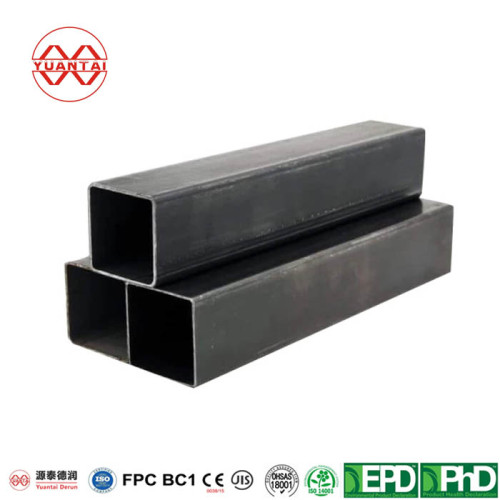

Beyond Basics: A Deeper Look at ASTM A36 Steel
Beyond Basics: A Deeper Look at ASTM A36 Steel
Most discussions about structural steel start and end with ASTM A36. It's presented as the universal, general-purpose option. But what does that actually mean for someone specifying materials for a real project?
A36 steel's significance goes beyond its technical specifications. To see its value, you need to understand its practical role—where it works best compared to other options.
Defining the "General-Purpose" Niche
ASTM A36 occupies a precise position defined more by what it isn't than by what it is. It is not a high-strength, low-alloy (HSLA) steel like ASTM A572 Grade 50. It won't match the corrosion resistance of weathering steel (ASTM A588).
It is designed for situations where the top priority isn't ultimate strength. In these cases, A36 stands out because it is predictable and quite easy for fabricators to use. The standard sets its chemical composition limits primarily to ensure excellent weldability and formability.
The Fabricator's Perspective: Where A36 Truly Shines
For machine shops and welding facilities, A36 is synonymous with efficiency. Its lower carbon equivalent means weld procedures are straightforward. Pre-heating before welding is rarely required for common thicknesses, eliminating a time-consuming and costly step.
When a drawing calls for A36, the fabrication team knows they can proceed with standard parameters, consumables, and techniques. This predictability translates directly into lower labor hours, fewer rejected parts, and reliable project timelines—factors often more critical than raw material cost.
The Engineer's Trade-off: Strength vs. Workability
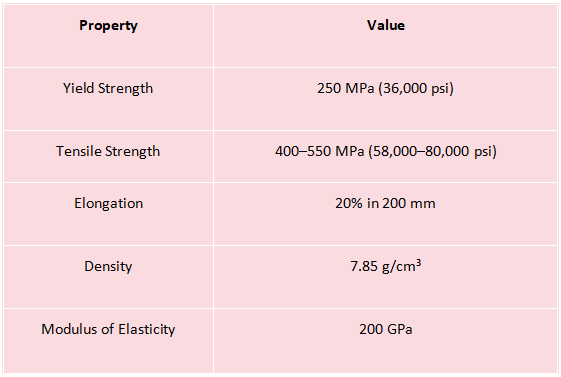
Designers choose A36 with a clear understanding of its mechanical ceiling. Its 36 ksi minimum yield strength provides a reliable baseline for calculations in static load applications like building frames, support legs, and base plates.
However, this choice inherently accepts greater material weight compared to using a higher-strength grade. Ultimately, engineers face a simple trade-off: should they use a thicker, easier-to-process piece of A36 steel, or choose a stronger steel that is thinner but more difficult to fabricate? The decision hinges on which option proves more cost-effective overall. In countless non-extreme applications, the math favors A36 because of its downstream fabrication advantages.
The Misconception of "Equivalents"
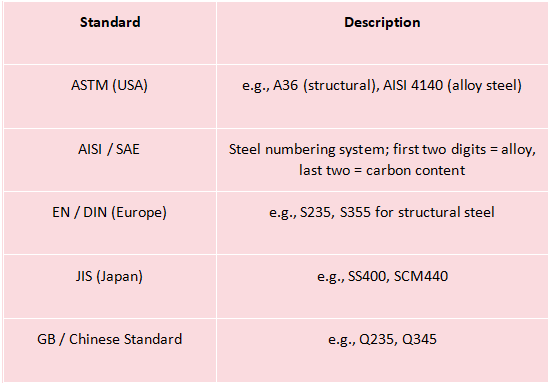
While international grades like S235JR or Q235 are functionally similar, they are not direct substitutes. Subtle variations in chemical limits (particularly for elements like phosphorus and sulfur) can affect bend performance or weld characteristics. For non-critical projects, the interchange might be acceptable.
For code-governed structural work, however, the specified standard (ASTM, EN, GB, JIS) is a legal part of the design. Material must be certified to the exact standard on the blueprint, not just a "close" equivalent.
Application in Context: Ideal Use Cases
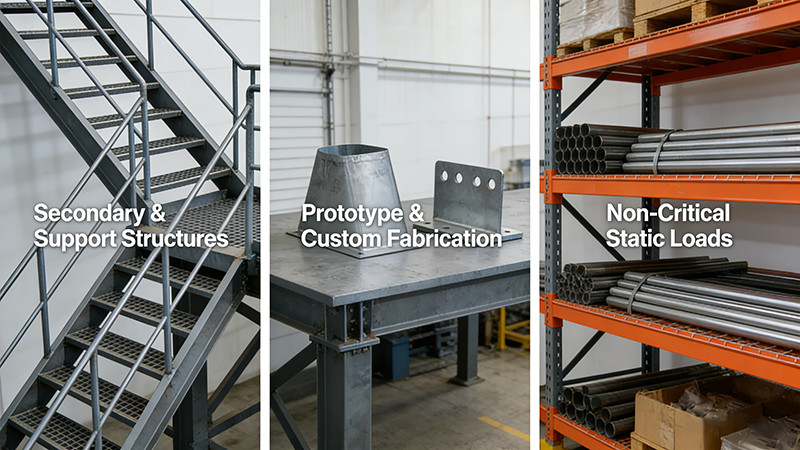
A36 is the optimal choice in predictable, well-defined scenarios:
Secondary & Support Structures: While high-strength steel may form a building's primary columns, A36 is ideal for stair stringers, platform framing, mezzanine decks, and equipment supports.
Prototype & Custom Fabrication: Its forgiving nature makes it perfect for one-off projects, custom machinery guards, or brackets where design iterations are possible.
Non-Critical Static Loads: Applications with stable, calculable forces—such as shelving systems, workbenches, and non-pressurized frames—are where A36 offers maximum value.
Conclusion: A Strategic Choice, Not a Default
ASTM A36 is not merely a "basic" steel; it is a strategically simple one. Its value proposition is operational smoothness. It reduces complexity in procurement, fabrication, and compliance for a vast segment of the structural market.
Selecting A36 is a conscious decision to prioritize manufacturability and cost control over maximizing strength-to-weight ratios. It remains fundamental not because it is the only option, but because for a huge class of ordinary challenges, it is the most practical one.