
ASTM A500 vs. ASTM A501: Technical & Procurement Guide for Structural Tubing
The fundamental distinction lies in their thermal history: A500 is a cold-formed product (strain-hardened, high residual stress), whereas A501 is a hot-formed product (stress-relieved, normalized, high toughness).
Below is a data-driven technical breakdown covering manufacturing metallurgy, mechanical properties, AISC 360 design rules, and procurement considerations.
1. Executive Summary: Core Comparison Table
Note: Updated to reflect the latest ASTM A501/A501M-21 code specifications.
| Technical/Commercial Parameter | ASTM A500 (Grade B / Grade C) | ASTM A501-21 (Grade B / Grade C) | Engineering & Sourcing Impact |
| Manufacturing Process | Cold-Formed (ERW or Seamless ) | Hot-Formed (>850℃) or ERW/SAW with full-body reheating | A501 eliminates strain hardening and corner residual stress completely. |
| Mechanical Properties | Gr.B:Fy ≥ 46 ksi(317MPa),FU≥58 ksi(393MPa)
Gr.C:Fy≥50 ksi(345 MPa),FU≥62 ksi(427MPa) | Gr.B:Fy≥46 ksi(315MPa),FU≥65 ksi(448MPa)
Gr.C:Fy≥50 ksi(345 MPa),FU≥70 ksi(483MPa) | A501 provides a higher Tensile/Yield ratio, guaranteeing larger plastic deformation reserves. |
| -18℃ (0°F) Impact Test | Not Required by standard (Risk of brittle fracture under subzero dynamic loads) | Mandatory for wall t>6.3 mm(0.250 in)
Avg ≥27 J(20 ft·lbf),Min Single ≥ 19 J(14ft·lbf) | A501 is strictly required for seismic bracing (BRBs), crane girders, and arctic climates |
Corner Radius (R) & Weld Location | Sharp outer corners (R≈2.0t), weld seam position flexible | Outer Corner: R ≤ 2.0t; Weld seam prohibited within the corner radius | A501 prevents corner strain-age cracking during heavy welding or galvanizing. |
AISC 360 Structural Design Factor | Effective design wall thickness = 0.93tnominal | Nominal wall thickness = 1.00t nominal (Full structural capacity) | A501 allows structural engineers to design slimmer, lighter steel columns. |
Market Availability & Cost | Mass-produced,widely stocked worldwide,lower cost | Project-specific mill run,higher thermal energy cost,premium price | Use A500 for general static framing;mandate A501 when required by design code. |
*Note: A501-21 introduces yield strength step-downs for heavy wall thickness (t > 25mm to 100mm).
2. Key Technical Differences Deep-Dive
A. Residual Stress & Cold Working Effects
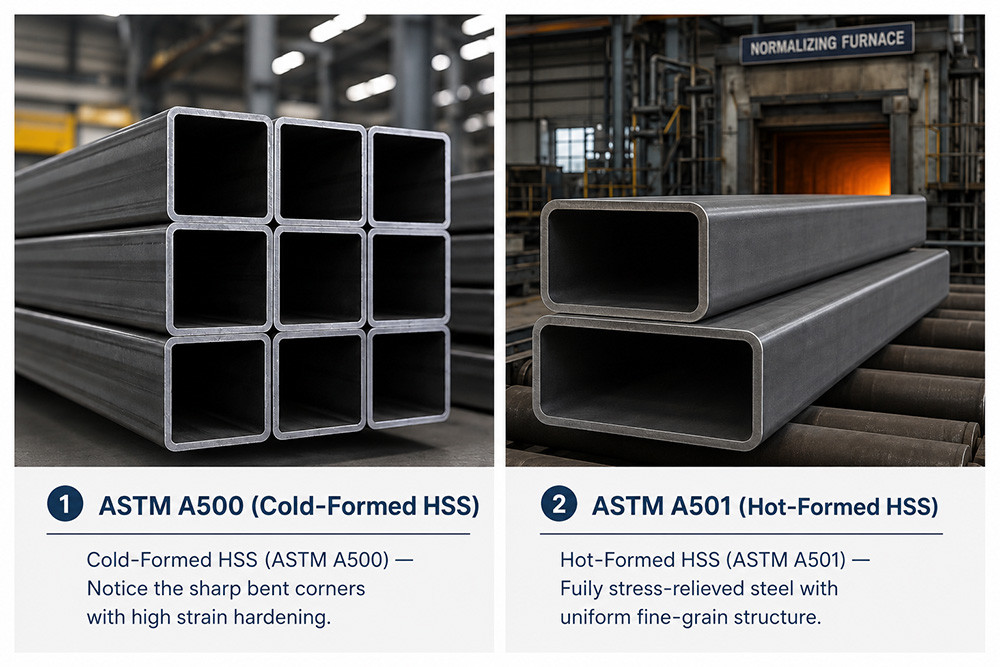
ASTM A500: Round coils are cold-bent into square/rectangular profiles at room temperature. This localized strain-hardening boosts yield strength at the corners but traps significant internal residual stress. When subjected to severe cyclic loads or hot-dip galvanizing (450℃), A500 can occasionally experience corner cracking or stress relief deformation.
ASTM A501: Tubing is shaped at elevated temperatures (>850℃). Thermal processing acts as a full-body normalizing heat treatment, resulting in a homogeneous fine-grain micro-structure with virtually zero residual stress.
B. Impact Toughness at Sub-Zero Temperatures
Under ASTM A501-21 Section 10, Charpy V-Notch (CVN) testing is mandatory for wall thickness exceeding 0.250" (6.3 mm). Standard 10 x 10 mm longitudinal specimens must achieve an average impact value of 20 ft ·lbf (27 J) at 0°F (-18℃), with no individual specimen falling below 14 ft·lbf (19 J).
ASTM A500 carries no baseline CVN requirement, making it unsuitable for unheated outdoor structural members in freezing environments without secondary testing.
3.Engineering Application & Procurement Guidance
Choosing between ASTM A500 and ASTM A501 goes beyond simple yield strength figures—it directly influences structural design factors, shop fabrication risks, and procurement lead times.
A. AISC 360 Structural Calculation Advantage
Under the American Institute of Steel Construction (AISC 360 Specification for Structural Steel Buildings):
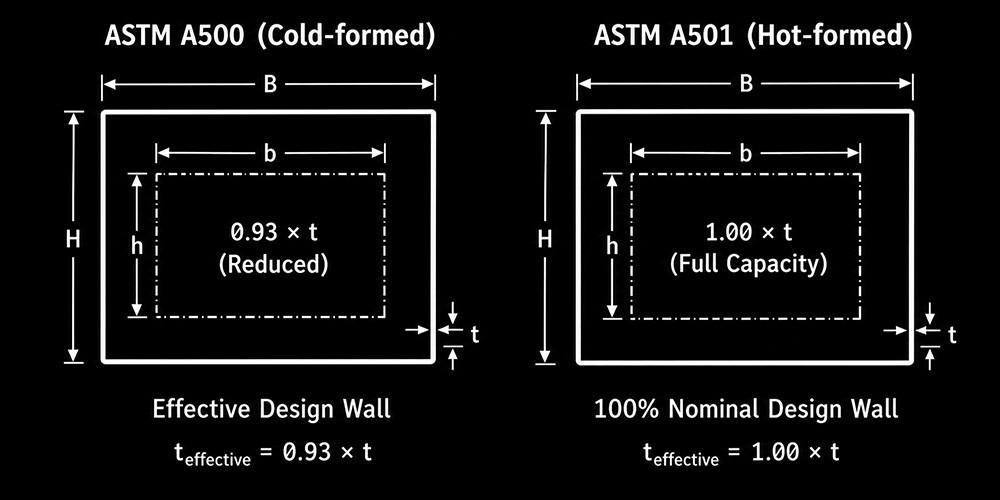
ASTM A500 (Cold-Formed): Because cold bending induces localized wall thinning and strain hardening, structural engineers must apply a 0.93 reduction factor (0.93 X tnominal) to nominal wall thickness when calculating section area, moment of inertia, and column buckling capacity.
ASTM A501 (Hot-Formed): Because hot forming produces a fully stress-relieved, uniform cross-section, structural calculations utilize 100% (1.00 X tnominal) of the nominal wall thickness. This allows engineers to design slim, highly efficient primary columns with higher axial load capacity.
B. Shop Fabrication & Galvanizing Safety
Hot-Dip Galvanizing (HDG): Cold-formed A500 square tubing retains high residual stresses around its bent corners. When submerged in molten zinc (450℃), this strain can occasionally trigger Liquid Metal Embrittlement (LME) or corner micro-cracking. A501's stress-relieved structure virtually eliminates galvanizing cracking risks.
Sub-Zero Fatigue: For outdoor structures operating in sub-zero ambient temperatures, A501's mandatory -18 ℃(0°F) Charpy V-notch impact toughness (≥ 27J) ensures complete resistance to brittle fracture under heavy dynamic loads.
C.Application Decision Matrix
| Application Scenario | Recommended Spec | Key Engineering & Sourcing Rationale |
| Standard Warehouses & Light Framing | ASTM A500 Gr. B/C | Static loading dominates; A500 offers lowest cost and immediate off-the-shelf inventory worldwide. |
| High-Rise Columns & Primary Frames | ASTM A500 Gr. B/C | Zero residual stress; allows 100% design wall thickness under AISC 360 rules. |
| Seismic Bracing (BRBs) & Dissipative Joints | ASTM A501-21 | High tensile/yield ratio provides massive plastic deformation reserves during major seismic events. |
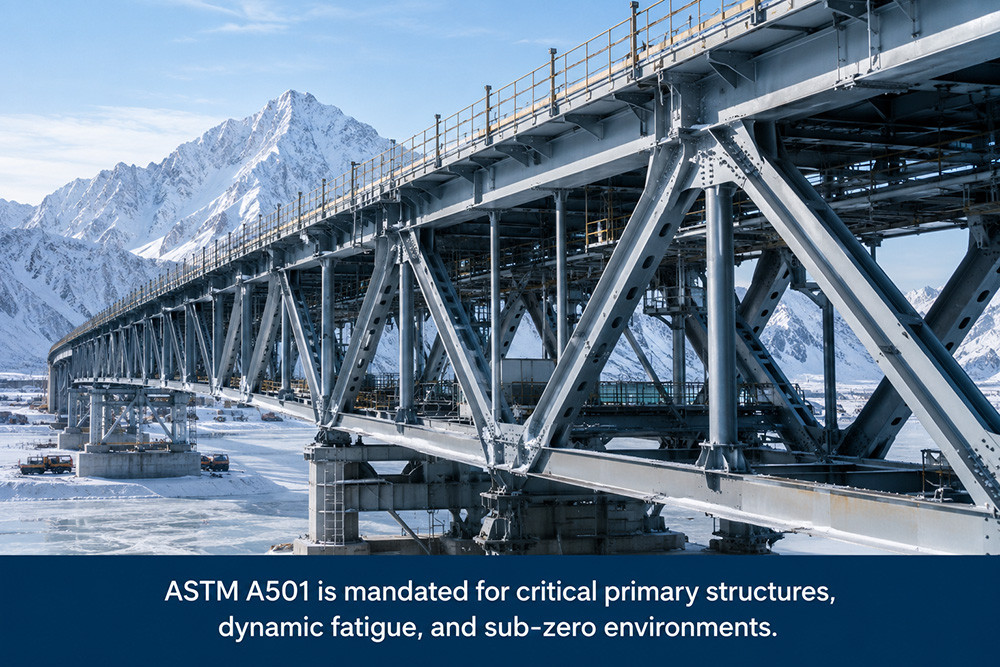
Bridges, Crane Runways & Dynamic Frames | ASTM A501-21 | Superior fatigue endurance; mandatory -18℃Charpy impact testing prevents brittle failure. |
D.Procurement Rule of Thumb & Substitution
· Rule 1 (Default for Static Framing): Specify ASTM A500 Grade B/C for commercial warehouses, curtain wall mullions, equipment skids, handrails, and standard building frames to optimize project budget and delivery time.
· Rule 2 (Code-Mandated & Dynamic Structures): Mandate ASTM A501-21 for primary columns, seismic braces, heavy crane girders, bridge trusses, or when drawings explicitly specify European EN 10210.
· Substitution Warning: Never substitute cold-formed A500 for hot-formed A501 without explicit written approval from the Engineer of Record (EOR).
FAQ
Q1: Can ASTM A500 be used as a direct substitution for ASTM A501?
A: Not without formal Engineer of Record (EOR) approval. While A500 Grade C and A501 Grade B share similar yield strengths (≈ 50 ksi/ 345 MPa), A500 contains high residual stresses and lacks mandatory -18℃ Charpy impact testing. Substituting A500 in a hot-formed design may violate building codes or reduce seismic fatigue life.
Q2: Why is ASTM A501 tubing more expensive and harder to find in stock?
A: A501 requires energy-intensive thermal processing (full cross-section reheating above 850℃or hot extrusion). Because most global steel service centers stock cold-formed A500 for general commercial construction, A501 is typically manufactured on a project-specific mill order basis.
Q3: Which standard is safer for Hot-Dip Galvanizing (HDG)?
A: ASTM A501 is significantly safer. Cold-formed A500 tubing retains high residual stress at its square corners. When submerged in a 450℃ molten zinc bath, this residual stress can occasionally trigger Liquid Metal Embrittlement or corner cracking. A501's stress-relieved structure virtually eliminates galvanizing cracking risks.
Q4: What is the ASTM A501 Grade B equivalent material in European and international standards?
A:The direct ASTM A501 Grade B equivalent material under European standards is EN 10210 S355NH or EN 10210 S355J2H (hot-finished structural hollow sections). For cold-formed equivalents (like ASTM A500), the corresponding European standard is EN 10219.
If a project drawing specifies EN 10210, ASTM A501 is the correct American equivalent.
Q5: What key items should buyers check on the Mill Test Certificate (MTC) for ASTM A501?
A: When inspecting an A501 MTC, verify three critical elements:
1.Thermal History: Confirmation of hot-forming or full reheating/normalizing treatment.
2.Charpy V-Notch (CVN) Test Results: For wall thicknesses > 6.3 mm (0.250 in), ensure the average impact value meets ≥27J(20 ft·lbf) at -18℃(0°F).
3.Corner Radius & Weld Location: Compliance with outer corner radius R ≤2.0t and non-corner weld placement.
Q6: Where can I find standard ASTM A501 dimensions and wall thickness tolerances?
A: Standard ASTM A501 dimensions cover square, rectangular, round, and special shape structural tubing up to 100 inches in perimeter, with wall thicknesses up to 1.000 in. (25.4 mm) for Grade B and Grade C under ASTM A501-21 specifications. Hot-formed manufacturing ensures tighter dimensional consistency and 100% full nominal wall thickness usage under AISC 360 design rules.